
 EN
The 2027 Countdown: The “Compliance Shift” in Plastic Bottle Sourcing Has Already Begun—Can Your Next Bottle Still Be Tooled to the Old Drawing?
1. What Is Happening Globally: From “Encouraging Recycling” to “Mandatory Compliance”
On August 12, 2026, the EU Packaging and Packaging Waste Regulation (PPWR) became fully applicable, covering all packaging placed on the EU market, including imports. The timeline is not a single cliff but a graduated tightening:
From 2028, empty-space reduction and sorting labeling obligations begin to roll out;
From 2030, all packaging must be designed for recyclability, with packaging below 70% recyclability facing market exclusion; mandatory recycled content targets also take effect—30% for contact-sensitive PET, 10% for contact-sensitive non-PET (including PP and HDPE), and 35% for non-contact-sensitive plastic packaging;
By 2040, those recycled content targets rise to 50%, 25%, and 65% respectively.
An easily underestimated variable sits in the U.S. New Jersey’s five-year exemption for rigid plastic food-contact packaging ends in January 2027, triggering a 20% PCR requirement; California, Washington, and other states are advancing their own PCR mandates and EPR frameworks. For squeeze sauce bottles and food-grade plastic bottles exported to North America, 2027 compliance documentation cannot wait until late 2026.
Brands are moving faster than regulation. L‘Oréal and Unilever already mandate a minimum of 50% PCR content in plastic packaging, with some premium lines targeting 100% PCR by 2027. PepsiCo and Hellmann’s launched squeeze bottles in Brazil made from 100% recyclable material with 60% post-consumer recycled plastic. Geka’s mascara packaging shown at Cosmoprof Bologna 2026 uses 100% post-consumer recycled plastic across the bottle, cap, wiper, and stem; Nele Kosmetik and Corpack’s hybrid lash care pack is designed in mono-material PP explicitly against PPWR requirements.
The implication: in 2027, brand sourcing teams will evaluate PCR readiness and mono-material capability alongside price—or ahead of it.
2. What It Means Across Your Six Product Lines
Plastic bottles / chemical bottles / spray bottles: rHDPE and rPP “material matching” matters more than price.
Under PPWR, the 2030 recycled content threshold for contact-sensitive non-PET packaging is 10%—seemingly modest, but food-contact and personal-care customers in 2027 will demand verifiable PCR origin and batch consistency ahead of the deadline. HDPE chemical bottles and spray bottle bodies are generally suitable for mechanical recycling; the real compliance bottleneck sits in pumps, valves, and dispensers. Conventional pumps contain metal springs, and mixed-material construction is inherently disadvantaged in recyclability assessment. PPWR pressure is driving a shift toward all-PP pumps, metal-spring elimination, and bottle-pump material unification. For a factory with in-house molds, this means pump fit dimensions, thread standards, and bottle weight must be validated at the tooling stage, not after the customer receives a compliance report and sends the design back.
Squeeze sauce bottles: PCR’s “engineering side effects” are the real moat.
PepsiCo’s 60% PCR squeeze bottle demonstrates that brands will pay for PCR—provided squeeze feel, rebound recovery, and seal integrity do not degrade. Industry practice shows that PCR content shifts color, odor, melt flow, and stiffness; lightweighting combined with PCR can trigger paneling, neck ovality, and higher leakage risk. Squeeze bottle importers are now treating “PCR readiness” and “functional retention after lightweighting” as standalone evaluation metrics, not footnotes. A tooling-capable factory’s advantage is not “can we run PCR”—it is whether PCR shrinkage and stiffness variation are built into wall-thickness distribution and neck tolerance at the mold design stage, with filled top-load testing replacing weight reduction as the validation logic.
Mascara bottles / cosmetic bottles: mono-material is moving from “trend word” to “design rule.”
Mascara packaging has historically relied on ABS and other materials for premium feel and mechanical performance, but ABS faces restrictions under recyclability frameworks. The 2026 trade-show signal is unambiguous: mono-PP, all-PCR, and recyclable design are replacing mixed-material construction as the default. A mascara pack involves the stem, wiper, bottle neck, and cap—mono-material conversion directly affects brush geometry, wiping performance, and dip/dispense behavior. This is precisely where mold and injection capability concentrate: mono-PP mascara bottles are not a resin swap; they require re-engineering flow paths, shrinkage compensation, and assembly tolerances. For a source factory with in-house molds and lines, this is an opportunity to proactively offer brand customers a “mono-material feasibility package,” rather than waiting for a frozen design and quoting against it.
Glue bottles: an underappreciated compliance-sensitive category.
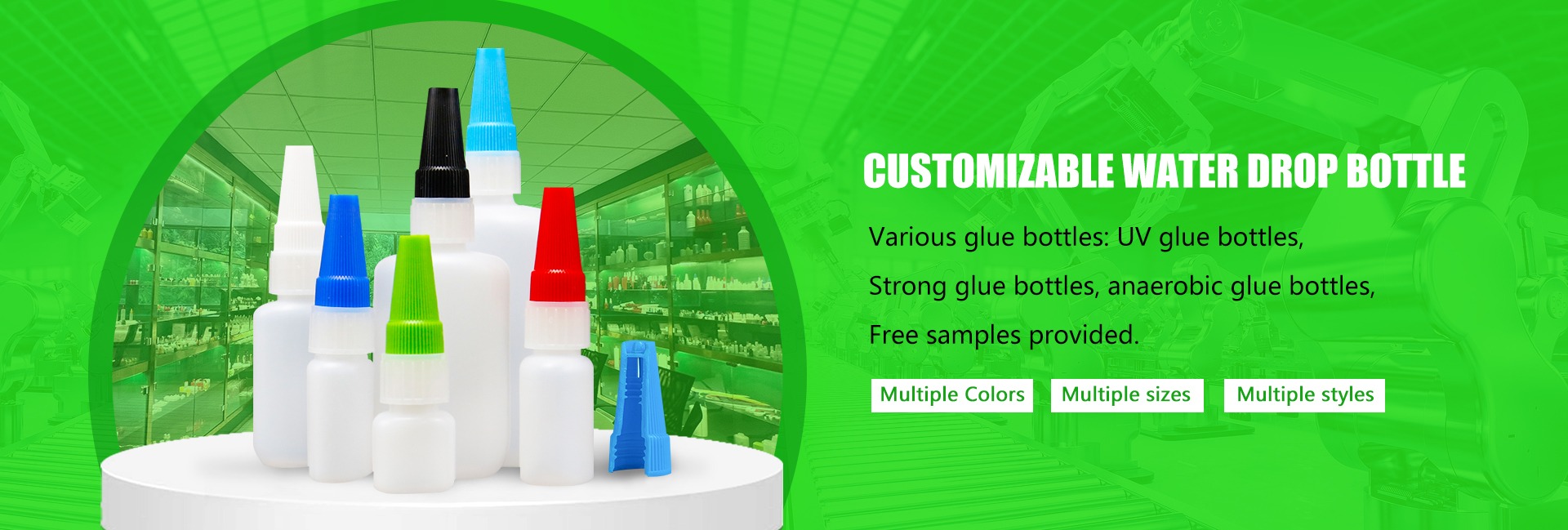
Glue and adhesive packaging faces compliance pressure from two directions: the bottle’s own PCR and recyclability profile, and the interference of labels and adhesive systems with the recycling stream. Market data shows the high-recyclability plastic packaging label and adhesive system segment growing from USD 304 million in 2026 to USD 713 million by 2036, at 8.9% CAGR. Brands are increasingly auditing “bottle + label + adhesive” as a system rather than sourcing them separately. For glue bottle suppliers, 2027 competitiveness will hinge on whether the bottle material, label compatibility, and recyclability declaration can be delivered as an integrated documentation package, not on extrusion capacity alone.
3. 2027 Plastic Bottle Outlook: Three Certainties
Certainty one: PCR moves from “premium option” to “entry requirement.” The global plastic packaging market is estimated at USD 509.4 billion in 2026 and projected to reach USD 597.4 billion by 2031, at roughly 3.24% CAGR—but growth share will concentrate among suppliers with PCR handling capability, mono-material design competence, and compliance documentation capacity. Smaller converters do not face disappearing demand; they face order migration driven by rising compliance costs. In 2027, factories without PCR-ready lines and material validation will be filtered out at the brand shortlist stage.
Certainty two: mono-material moves from “design concept” to “mold engineering.” PPWR recyclability thresholds and brand PCR commitments together turn mono-material into a hard constraint. But mono-material conversion in injection and blow molding introduces shrinkage, stiffness, and sealing changes that must be absorbed through mold flow paths, cooling, and wall-thickness design. This is why 2027 sourcing logic will tilt toward source factories with in-house molds and production lines: brands need deployable mono-material solutions, not a material declaration.
Certainty three: “audit-ready at the factory gate” becomes standard. Squeeze bottle importers are already being asked for food-contact documents, PCR batch traceability, and digitally scannable labeling records; chemical bottle and spray bottle customers are likewise adding material compliance statements, recyclability grades, and component-level bills of materials to supplier scorecards. In 2027, source factory competitiveness is not just “we can make the bottle”—it is the compliance file is ready when the bottle leaves the line.
4. Practical Takeaways for Buyers (Directly Usable as Sales Talking Points)
Do not leave PCR inquiry until after design freeze. Once a mold is cut to virgin-resin shrinkage, switching to PCR introduces dimensional drift and surface defects that sharply raise remediation cost. In the 2027 window, material route should be locked before tooling commitment.
Ask for component-level material lists, not just bottle-body declarations. Pumps, valves, gaskets, stems, and label adhesives all affect recyclability assessment and the PCR accounting boundary.
Validate lightweighting with filled top-load, squeeze recovery, and temperature-cycling tests—not weight reduction alone. The combined effect of PCR + lightweighting is a cost saving only after functional validation; otherwise it is a claims source.
Prioritize suppliers where mold, injection/blow molding, and compliance documentation are closed-loop under one roof. Cross-party coordination time will be amplified under the 2027 compliance cadence.
